
News
Total Cost of Ownership: SF₆ GIS vs SF₆-Free Dry-Air GIS
When utilities, EPCs, and industrial operators compare medium-voltage (MV) gas-insulated switchgear (GIS), the discussion often starts — and sometimes ends — with purchase price. However, MV switchgear is typically operated for 30 to 40 years, and many of the most significant costs occur after installation.
This is where Total Cost of Ownership (TCO) becomes the relevant metric. TCO captures not only the upfront investment, but also the long-term costs associated with operation, maintenance, compliance, risk, and end-of-life handling.
This article compares the TCO of conventional SF₆ GIS with SF₆-freedry-air GIS, and explains how while upfront costs between SF₆ and SF₆-free GIS are broadly comparable, lifecycle analysis shows that SF₆-free dry-air GIStypically delivers 20–30% lower total cost of ownership over a 30-year servicelife, driven by the elimination of gas management, compliance, disposal, and risk-related costs.
1. What Is Total Cost of Ownership (TCO)?
TCO considers all costs incurred over the full lifetime of an asset, including:
- Capital expenditure (CAPEX)
- Installation and commissioning
- Operation and maintenance (OPEX)
- Regulatory compliance and reporting
- Risk and contingency costs
- End-of-life handling and disposal
For MV switchgear with long service lives, OPEX and risk-related costs often exceed the initial purchase price.
2.CAPEX: Purchase Price and Installation
SF₆ GIS
Historically,SF₆ GIS has benefited from:
- Long industrial maturityH
- Highly compact designs
- Highly compact designs
- Established supplier base
This often translates into competitive upfront pricing, especially for standardised projects.
However, installation typically includes:
- Gas filling and density checks
- Certified SF₆ handling personnel
- Documentation for gas inventories
SF₆-Free Dry-Air GIS
Modern dry-air GIS:
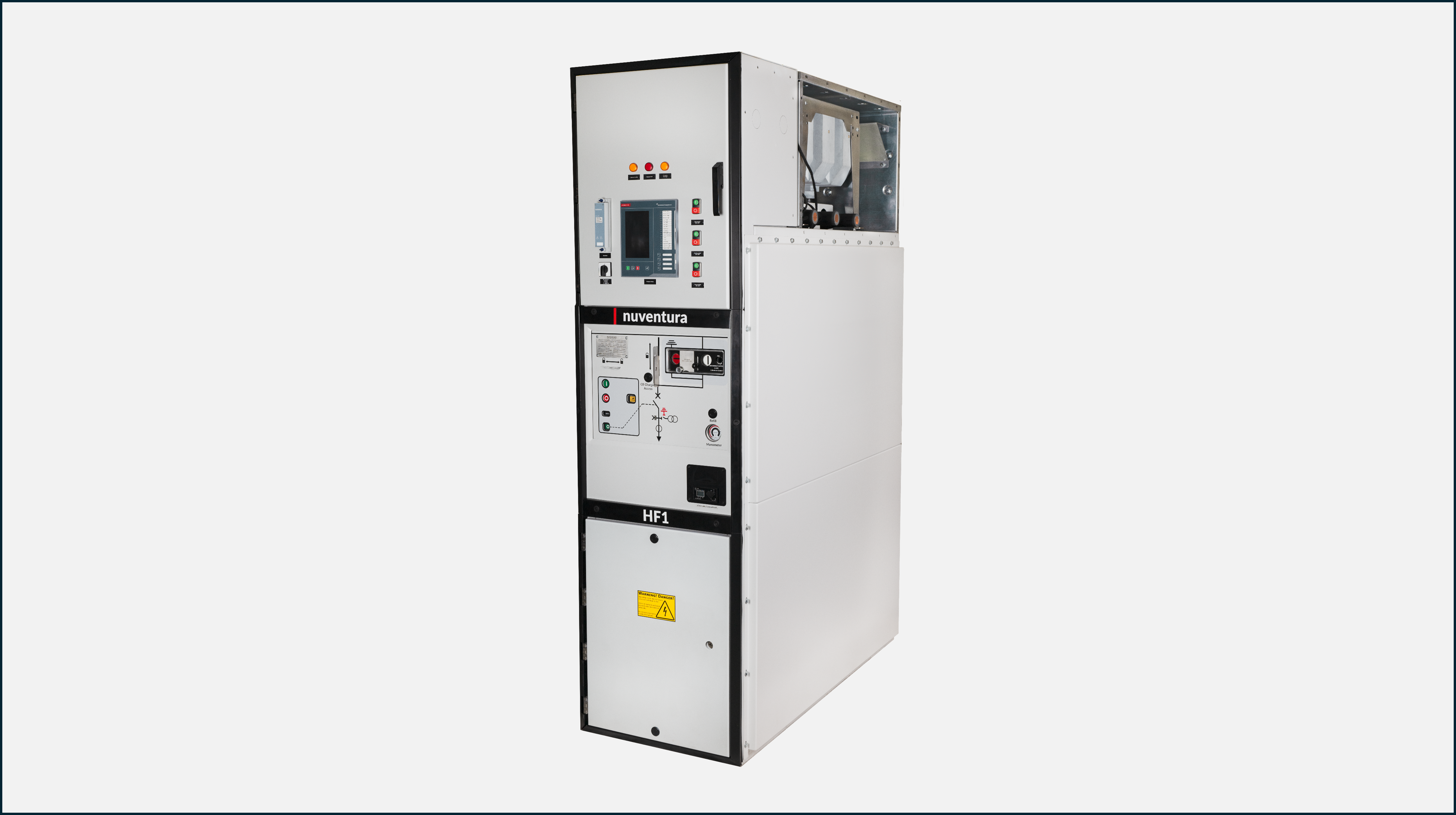
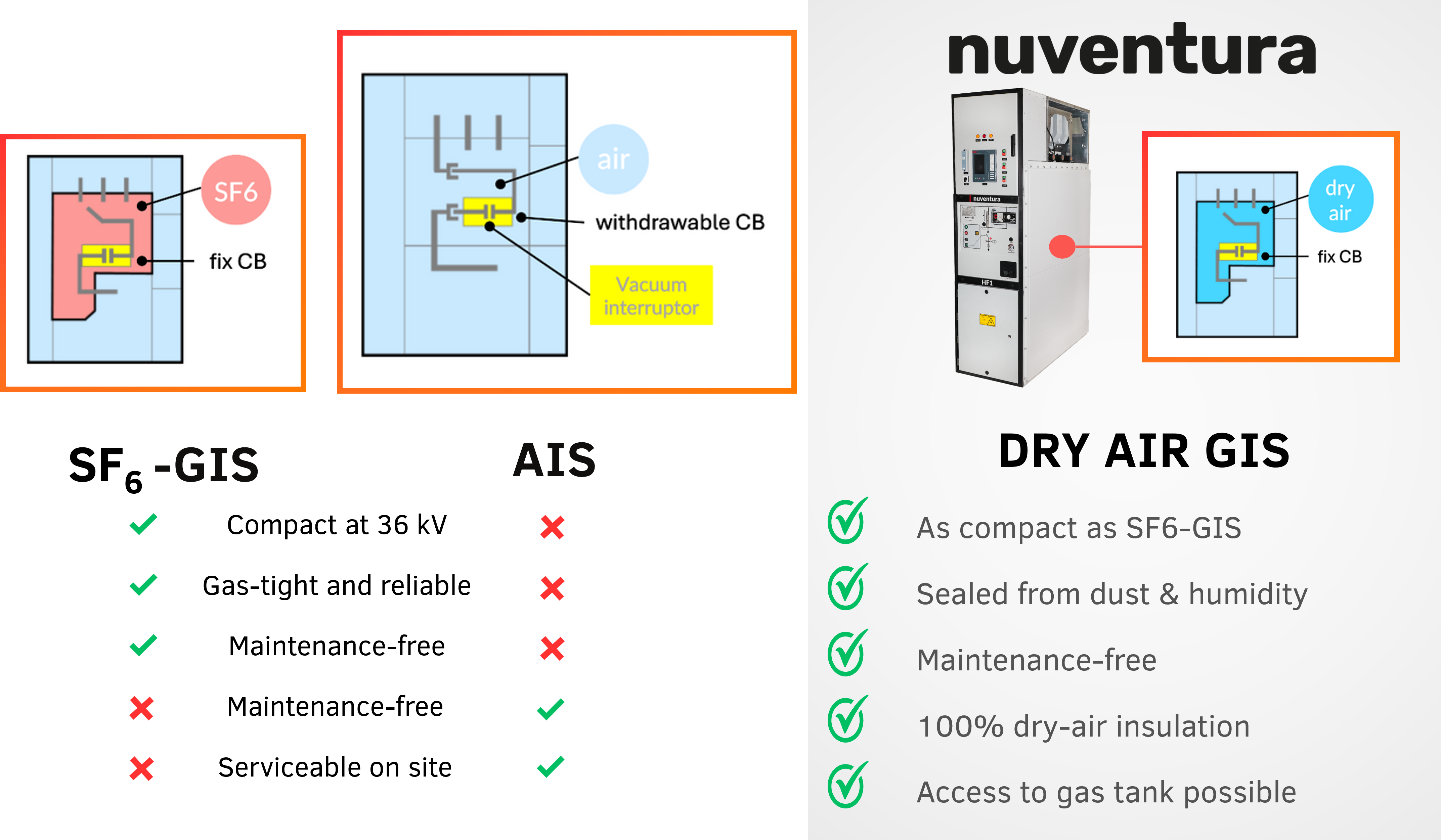
- Matches SF₆ GIS in footprint and functionality
- Uses vacuum interrupters and air insulation
- Operates at neat-atmospheric pressure
Installation is simpler:
- No gas filling procedures
- No special gas handling equipment
- Reduced commissioning complexity
CAPEX difference today is often marginal — and decreasing as SF₆-free adoption scales.
3.Operational Costs During Service Life
3.1 Gas Management and Monitoring
SF₆ GIS
- Continuous gas density monitoring
- Alarm thresholds and interlocks
- Periodic leak checks
- Inventory tracking and reporting
SF₆-Free Dry-Air GIS
- No greenhouse gas management
- No density monitoring required
- No regulatory gas reporting
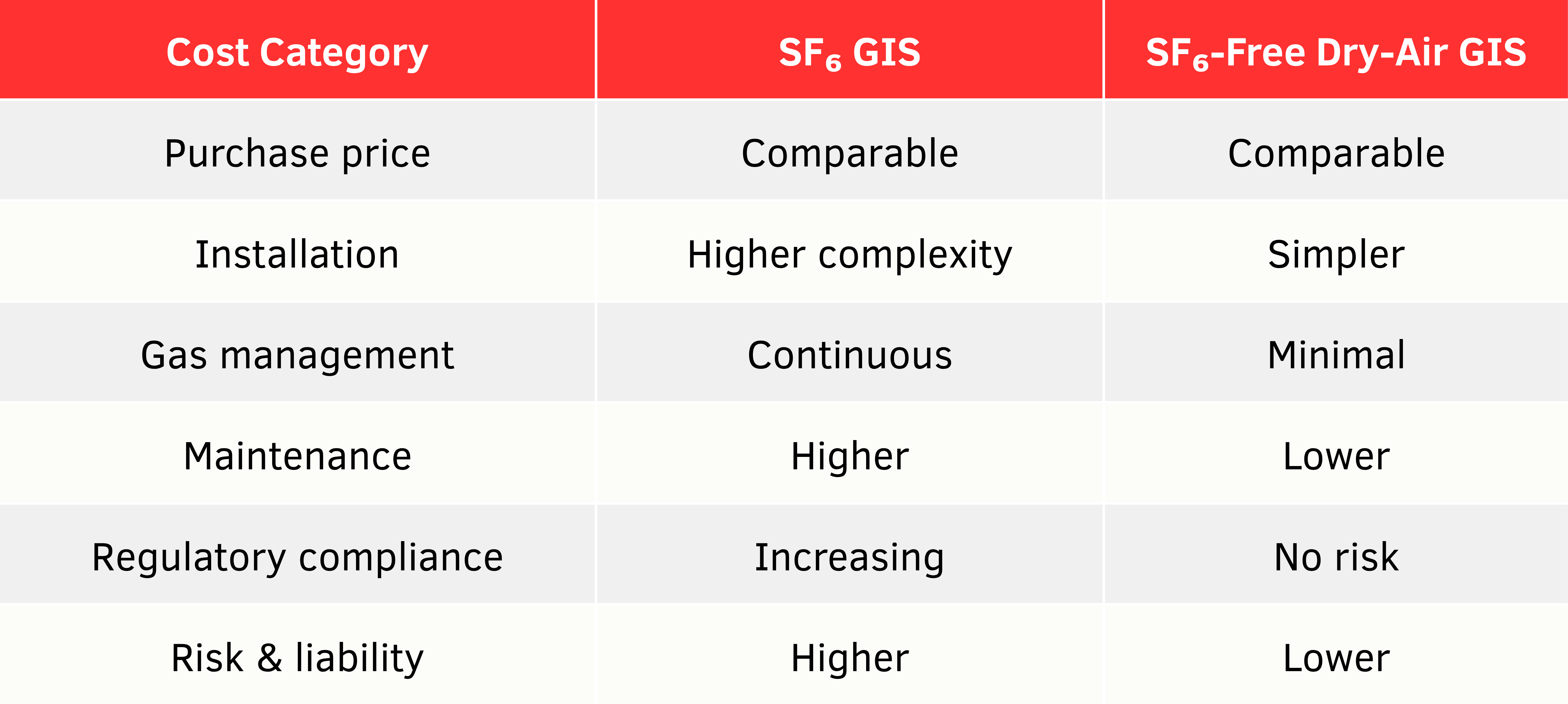
Over decades, these activities translate into measurable recurring costs for SF₆ GIS that simply do not exist for dry-air systems.
3.2 Maintenance and Personnel Requirements
SF₆ GIS
- Certified SF₆ technicians required
- Special PPE during interventions
- Decontamination procedures after faults
- Higher training and safety over head
SF₆-Free Dry-Air GIS
- Standard electrical maintenance procedures
- No toxic arc by-products
- Lower safety complexity
This reduces both direct maintenance cost and indirect organisational over head.
4.Regulatory and Compliance Costs
Regulatorypressure on SF₆ continues to increase globally.
SF₆ GIS
Operators face:
- Mandatory gas inventories
- Leakage reporting
- Compliance audits
- Potential carbon pricing exposure
- Future retrofit or replacement risk
These costs are difficult to predict — and tend to increase over time, not decrease.
SF₆-Free Dry-Air GIS
- No F-gas reporting
- No GWP exposure
- Lower regulatory uncertainty
From a TCO perspective, regulatory risk is a real cost, even if it does not appear on a purchase order.
5.Risk-Related Costs: Failures, Outages, and Liability
Internal faults and arc events
SF₆ GIS
- Arc decomposition creates toxic and corrosive by products
- Extended downtime for clean-up
- Specialist intervention required
- Higher occupational safety risk
SF₆-Free Dry-Air GIS
- No toxic decomposition products
- Faster return to service
- Lower clean-up and liability costs
Even rare events have disproportionate economic impact, especially in urban or industrial substations.
6.End-of-Life Costs: A Major Hidden Differentiator
SF₆ GIS
End-of-lifehandling involves:
- Certified gas recovery
- Transport of hazardous gas
- Storage or destruction at specialised facilities
- Residual emission risk
SF₆disposal is technically complex and expensive, and in many cases gas isstored or reused rather than definitively destroyed — creating long-termliability.
SF₆-Free Dry-Air GIS
- No greenhouse gas recovery required
- Standard dismantling procedures
- No disposal-related climate risk
From a TCO perspective, end-of-life costs alone can offset any initial CAPEX advantage of SF₆ GIS.
7. Comparative TCO Overview
8. Why TCO Is Becoming the Decisive Metric
As grids expand to integrate renewables, data centres, EV charging, and electrified industry, utilities are deploying more MV switchgear than ever before. Small per-asset cost differences therefore scale rapidly at fleet level.
In this context:
- Technologies with lower uncertainty
- Fewer regulatory dependencies
- Simpler operation deliver superior long-term economics — even if upfront pricing is similar.
While SF₆GIS has historically been selected based on compactness and familiarity, its total cost of ownership tells a different story when viewed over the full assetlifetime.
SF₆-freedry-air GIS typically delivers 20–30% lower total cost of ownership over a30-year service life because of the following:
- The elimination of gas management and disposal costs
- A reduction of maintenance and safety overhead
- The avoidance of long-term regulatory and climate risk
- Greater cost certainty over 30–40 years
When evaluated on TCO rather than purchase price alone, SF₆-free GIS increasingly represents the economically superior choice for modern MV networks.
Stay informed and inspired
You can also stay informed and inspired by subscribing to our quarterly newsletter

More News
.png)



Nuventura joins Lucy Electric to accelerate global adoption of SF₆-free primary switchgear

Total Cost of Ownership: SF₆ GIS vs SF₆-Free Dry-Air GIS
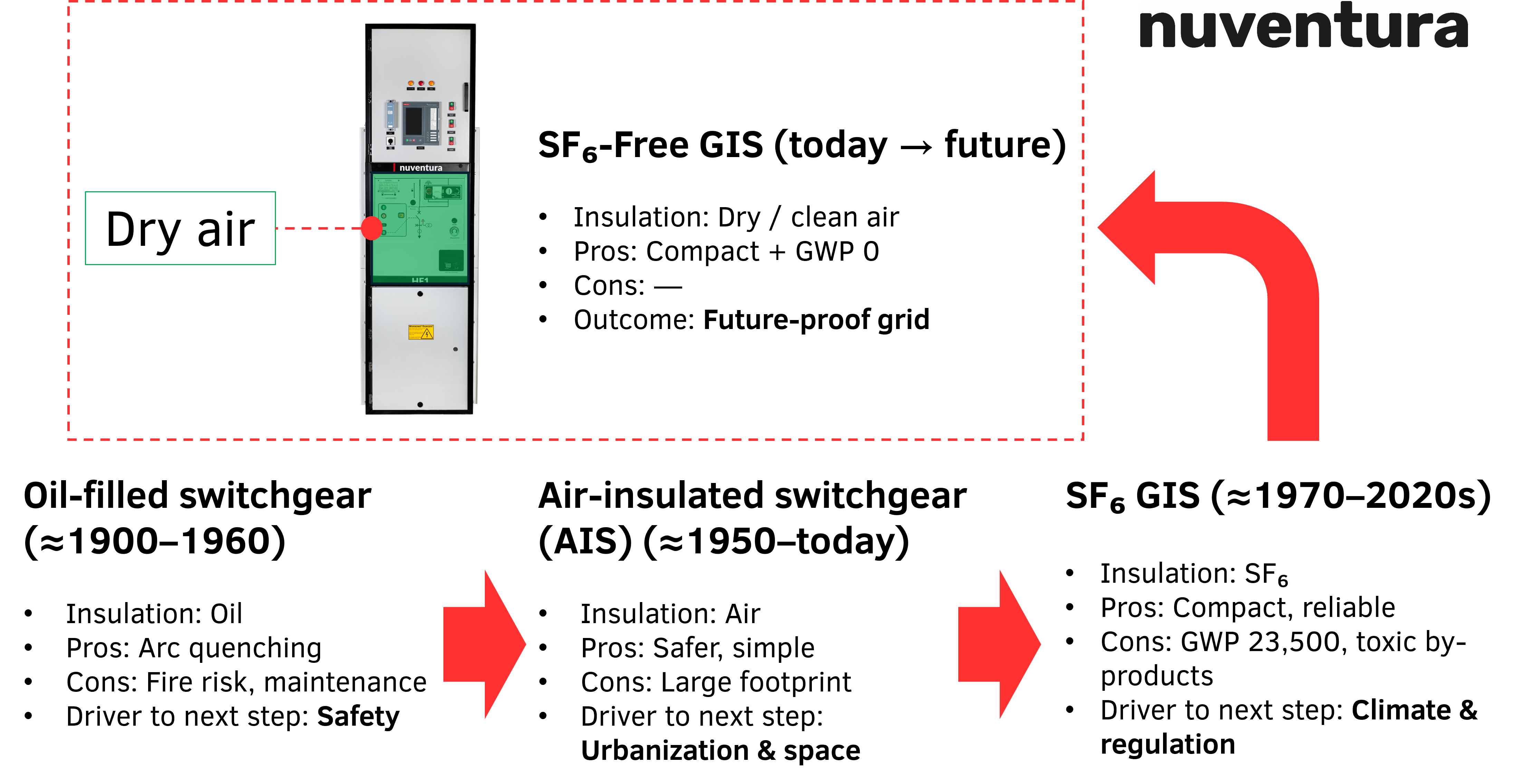
The Evolution of MV Switchgear: From Oil → AIS → SF₆ → SF₆-Free GIS
The Carbon Footprint of SF₆ vs SF₆-Free Switchgear
What Utilities Must Consider in Tender Specifications for SF₆-Free GIS
.png)
Type-Tested MV Switchgear Under IEC 62271-200
_sz3.jpg)
Partial Discharge in MV Switchgear: Causes & Detection
.png)
Key Differences between Primary and Secondary GIS Switchgear
Internal Arc Classification Explained (IAC AFLR, 16/25/31.5 kA Basics)
Environmental Advantages and Potential Carbon Credits to SF₆-free Switchgear in the Indian Context
SF₆ Regulations: What’s Changing (2026–2035)? And Where?
Explanation of the relay protection functions required in MV grids
AIS vs GIS — Combining the Best of Both Worlds with SF₆-Free Technology
Why Voltage Levels Matter in Medium-Voltage Grids
Protection Relays – The Intelligence Behind Medium-Voltage Switchgear
Raising the Bar for Switchgear Safety
Nuventura and Elgór and Hansen enter partnership to bring SF₆-free switchgear to Poland
Nuventura and WESCOSA join forces to bring F-Gas-free GIS to the Middle East

CO7 and Nuventura announce partnership

Nuventura and PMS join forces for a greener future in power solutions

Introducing Nuventura’s ESG function and Cassidy Kuiper
Project Enquiries
Whether it’s SF₆-free switchgear specifications, partnership opportunities or support – our team is ready to answer your questions and find the right eco-friendly solution for your needs.
If you are evaluating SF₆-free switchgear for a new project or looking to replace conventional GIS, our team can help you define the right technical solution. We support customers with product specifications, project planning, partnership discussions and technical clarification throughout the decision-making process. Whether the application is utility, industrial or renewable energy, we work with you to identify the most suitable configuration for your requirements. Contact us to discuss your project in more detail and explore the best SF₆-free option for your application.
Do you have a specific request?
Get in touch