
News
Environmental Advantages and Potential Carbon Credits to SF₆-free Switchgear in the Indian Context
Authors:
- Amol Patharkar
- Cassidy Kuiper
- Probal Sarkar
- Lucas Zaehringer
INTRODUCTION:
Sulphur hexafluoride (SF6) has been widely used as an insulating and arc quenching medium in high and medium voltage (MV) switchgear due to its excellent dielectric properties and long-term stability. However, SF6 is a synthetic greenhouse gas (GHG) with an extremely high Global Warming Potential (GWP) of 24,300 tons of CO2 [1], making it one of the most potent GHGs in use today. Unfortunately, 80% [2] of the SF6 is used in GIS & the expected growth in SF6 use is 75 % from 2019 levels to 2050 [2]. SF6 emissions contribute significantly to climate change due to its long atmospheric lifetime exceeding 3,000 years [3]. As India rapidly expands its power infrastructure in line with its economic growth and the and electrification goals, the cumulative environmental impact of SF6 emissions from the power sector cannot be ignored.
With India committing to reduce its emissions intensity by 45% by 2030 [4], under its Nationally Determined Contributions (NDC), there is a growing need to adopt sustainable technologies in the energy sector. SF6-free switchgear has emerged as a viable and environmentally friendly alternative, utilizing insulation technologies such as dry air technology.
This paper evaluates the environmental advantages of transitioning to SF6-free switchgear (dry air) majorly primary MV switchgear in the Indian context. It also explores the commercial opportunities linked to carbon finance, specifically the potential to earn carbon credits under emerging Indian and international carbon market mechanisms. The discussion includes economic implications of deploying SF6-free solutions. The adoption of these technologies can directly reduce India's GHG emissions, contribute to national climate goals, and position utilities and manufacturers to benefit from future carbon pricing systems. Through supportive policy frameworks and industry participation, India could lead in sustainable power infrastructure by eliminating one of the most harmful industrial GHG from its grid systems.
India’s Energy Landscape:
India, with an estimated population of 1.46 billion (2025) [5], continues to experience steady and inclusive growth in electricity demand. Per-capita energy consumption has risen from 748 kWh in 2014–15 to 1,106 kWh in 2023–24, representing a CAGR of 3.74% [6]. India has experienced a steady and healthy growth in both energy supply and consumption to fulfil the dream of becoming a Viksit Bharat by 2047.
Grid Infrastructure in India:
As of June 2025, India’s installed generation capacity stands at 476 GW [7], distributed across central sector: 22.5%, state sector: 23.2%, and private sector: 54.3%. At approximately 80% utilisation, the effective generating capacity is 396 GW. This power is transmitted through a multilayered grid comprising HV, MV, and LV networks, accounting respectively for 10%, 30%, and 60% of total transmission, which translates to incoming power flowing through HV network 39667 MW, MV network 119000 MW, and LV (via MV network) 238000 MW. This is an assumption made in this paper and can be adjusted as and when better datasets are available.
It is assumed that the network predominantly employs Air-Insulated Switchgear (AIS) for around 60% of installations, with SF6-based GIS accounting for the remaining 40%, particularly in space constrained or critical installations. While technically efficient, these SF6 based systems contribute heavily to GHG emissions both during operation and at end-of-life gas recovery. Due to its techno-commercial advantage, conventional GIS relies heavily on SF6 gas, a synthetic compound that is colourless, odourless, non-flammable, and highly effective for arc-quenching and insulation. Despite its technical merits, SF6 is a GHG with an extremely high GWP 24,300 times that of CO2 and an atmospheric lifetime of over 3,000 years. To assess the true scale of the SF6 challenge, it is essential to first estimate the quantity of SF6 currently deployed in MV switchgear across India. However, due to the absence of comprehensive national data on the installed base of MV SF6-GIS and their projected growth, precise figures are not readily available.Therefore, the following sections present an analytical estimation of the overall SF6-GIS population within India’s MV switchgear network.
Estimating the SF6 Footprint in India’s MV Switchgear
In Indian context, the incoming powerflowing through MV network can be classified with respect to voltage level i.e., 11 kV (50%), 22 kV (10%) and 33 kV (40%), which translates to 71,400 MW, 14,280 MW and 57,120 MW, respectively, for each voltage level.

Assuming each GIS is rated for 1250 A,the power flowing through it will be 18 MW, 36 MW and 54 MW, respectively.
Every substation has an incoming and outgoing power flow through these SF6-GIS, and the average line up is about 10 panels. Thus, each voltage level has the approximate number of installed SF6-GIS as follows:
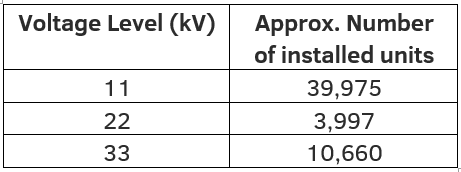
SF6 GAS IN USE (MV):
The following amounts of SF6 are used in the different voltage levels of SF6-GIS [8] [9]:
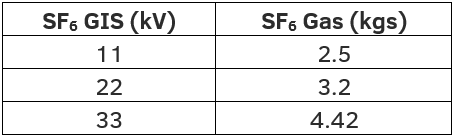
Thus, the total amount of SF6 gas present in India’s MV Switchgear as of today is approximately:
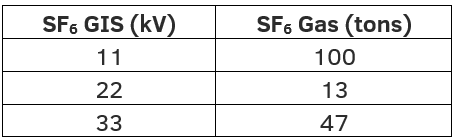
Therefore, the total SF6 used only in MV switchgear in India by mid-2025 accounts to approximately 160 tons, equivalent to 3.9 million tCO2e in the atmosphere for next 30 years.
Further, the data also shows the average annual growth rate of installed capacity is at a rate of 5-6% i.e., as theinstalled capacity of India’s MV switchgear increases from 476 GW to 852 GW between 2025 to 2035, the total SF6 gas in use would amount to 286 tons therefore equating to 6.9 million tCO2e (approximately double the SF6 gas used in 2025).
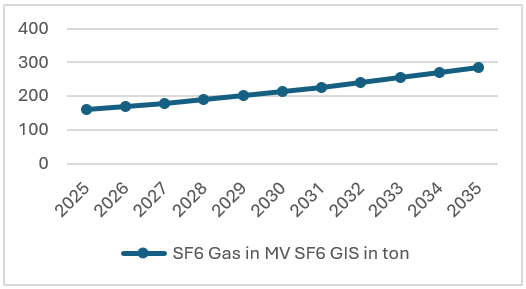
ALTERNATIVESTO SF6 IN MV SWITCHGEARS
SF₆ has long been the dominant insulating and arc-quenching medium in medium-voltage (MV) GIS. Its exceptional dielectric strength, roughly two to three times that of air under identical conditions, combined with thermal stability, non-flammability, and high electron affinity, has enabled compact equipment designs and reliable operation for decades. These technical advantages have made SF₆ the preferred choice inapplications demanding high performance and minimal maintenance.
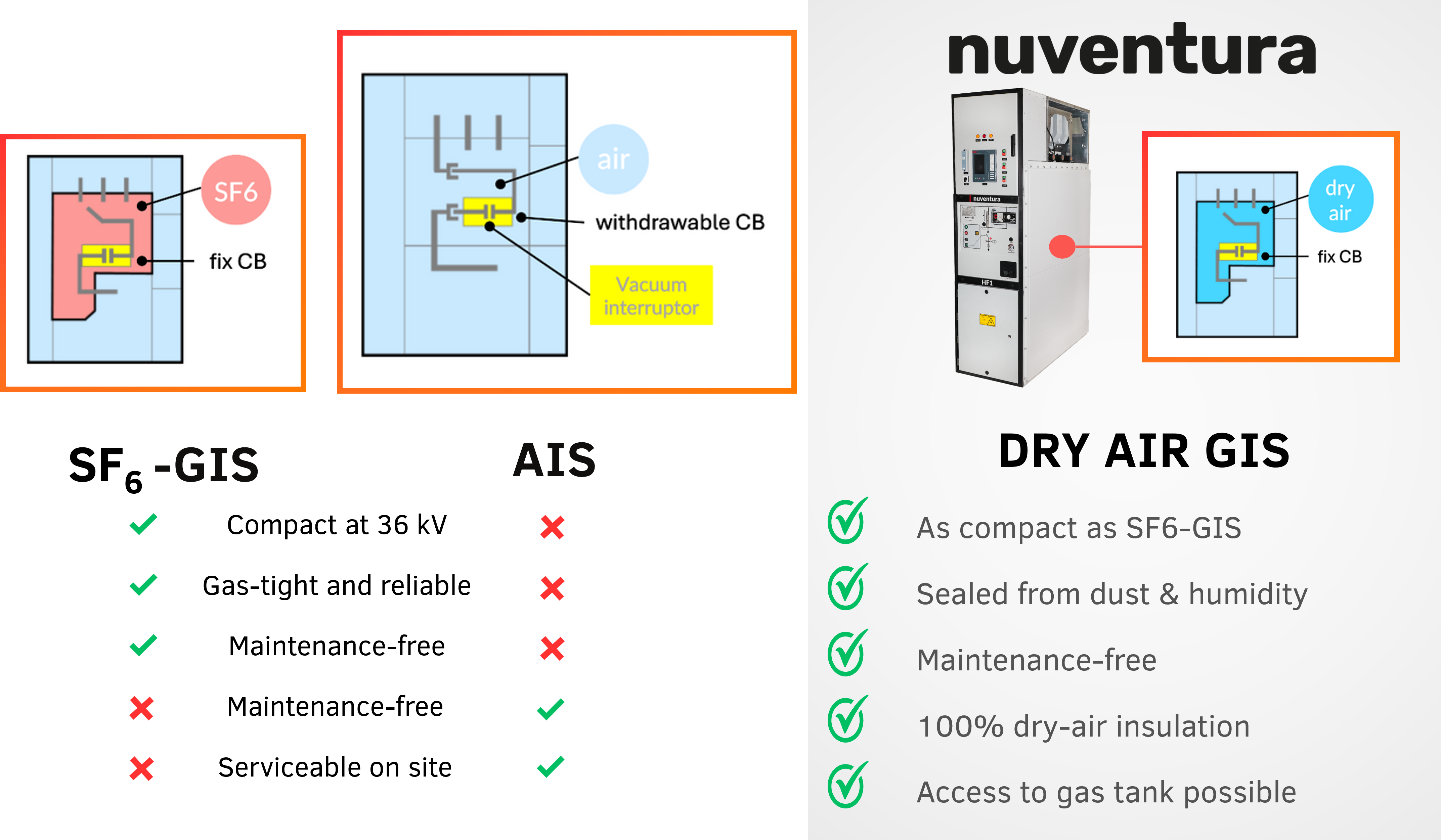
In recent years, however, the industry has moved toward more sustainable insulating technologies that can match the electrical and mechanical performance of SF₆ while avoiding its environmental drawbacks. Several mature alternatives are now available for MV applications. The most prominent are dry air, fluoronitrile-based mixtures (e.g., C₄ or C₅ compounds blended with N₂ or CO₂), CO₂-based mixtures, and vacuum interruption technology combined with either solid or gaseous insulation. In modern GIS designs, current interruption is achieved by a vacuum interrupter,while the surrounding medium provides insulation only. Among these options, dry air has emerged as the most practical and sustainable solution due to its natural composition, zero GWP, non-toxicity, and wide availability. In contrast, fluoronitrile or CO₂ mixtures require carrier gases, more complex handling procedures, and careful temperature control to prevent condensation. For these reasons, dry-air systems are particularly well-suited to medium-voltage networks up to 36 kV, offering both technical reliability and regulatory simplicity.
The dielectric behaviour of gaseous insulants is governed by Paschen’s law, which relates breakdown voltage to the product of gas pressure and electrode gap [10]. SF₆ achieves superior dielectric strength at lower pressures, whereas natural gases such as dry air or nitrogen require higher pressures to reach equivalent performance. Comparative measurements show that while SF₆ operates effectively between 0.1 and 0.7 MPa, dry air must be compressed to approximately three times that pressure to deliver similar insulation strength (see Figure 3) [10].
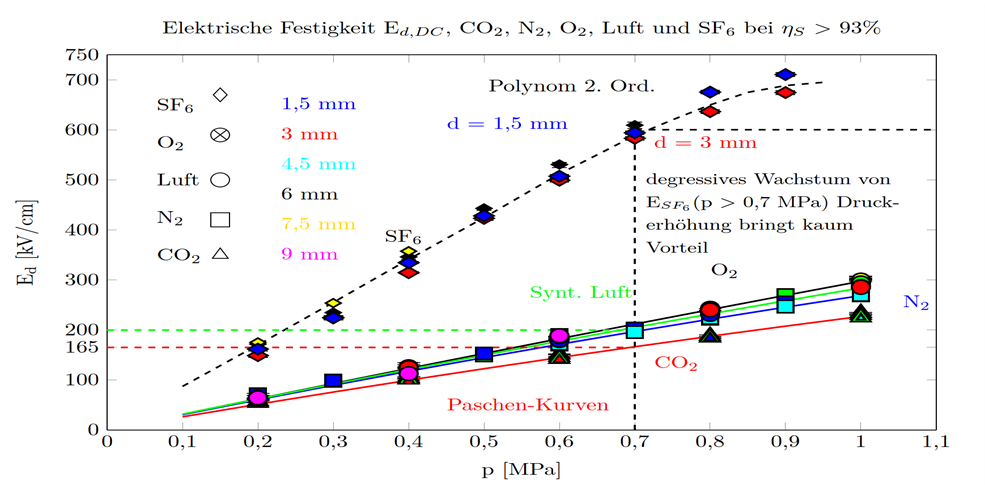
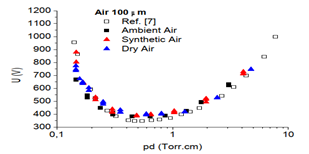
Experimental results by Štefan Matejčík confirm that the breakdown voltage in air, oxygen, and nitrogen increases proportionally with pressure (Figure 4) [11]. For MV switchgear rated up to 36 kV, an operating pressure of around 2 bar (g) moves the gas well beyond the Paschen minimum, providing a stable dielectric margin and reliable protection against partial discharges and internal arcs.
Maintaining this higher internal pressure safely depends on modern design and manufacturing standards. Contemporary GIS tanks are engineered according to IEC 62271-200 [12], whichs pecifies internal arc classification, functional safety, and dielectric requirements, and EN 50187 [13], the latest European standard for pressurized enclosures. These standards permit operating pressures above 3 bar while enforcing stringent quality and safety measures such as hydrostatic testing, burst-disc installation, and helium leak verification in line with IEC 62271-1 [14]. By using certified stainless-steel tanks, precision welding, and full traceability of components, manufacturers can ensure long-term gas tightness and mechanical integrity even under demanding service conditions.
In summary, while SF₆ remains a benchmark for dielectric performance, advances in gas pressure management and manufacturing now enable dry air insulated switchgear to deliver equivalent reliability and compactness without environmental compromise.
Lifecycle Emission Reductions
Electric utilities have historically relied on SF6-GIS, which experiences leakage throughout its operational life and particularly at end-of-life during gas recovery. Even minor leaks therefore result in significant CO2-equivalent (CO2e) emissions due to SF6’s extreme GWP [15].
An internal Life Cycle Assessment (LCA)conducted for Nuventura’ s Nu1, conducted using a functional unit representing a MV GIS (≤ 36 kV) over a 20-year reference lifetime, found that replacing SF₆ with dry-air insulation eliminates the direct GHG emissions associated with SF₆ use. Assuming a scenario of 2% annual SF6 leakage during the use phase, the LCA indicated that an SF6-GIS would produce approximately 31 tCO2e more emissions over the 20-year period compared to the dry-air alternative. Although end-of-life gas recovery is often excluded from such assessments, SF₆ handling can be complex and prone to additional leakages meaning the overall environmental burden could besignificantly higher when this stage is considered. In addition to eliminating direct emissions, SF6-free GIS also reduce lifecycle impacts by reducing maintenance requirements, simplifying logistics, and removing the needfor end-of-life gas recovery.
As India rapidly expands its power infrastructure to meet growing demand, the large-scale deployment of new switchgear presents a critical opportunity to adopt SF6-free technologies. This transition could avoid thousands of tonnes of CO2e emissions annually, directly supporting India’s commitment to reduce emissions intensity by 45% by 2030 [4].
ESG Alignment and market advantage for Utilities and Manufacturers
As a major global economy and GHG emitter, India plays a pivotal role in advancing international sustainability efforts. Environmental, Social, and Governance (ESG) considerations have become integral in Indian corporate strategy, supported by evolving regulatory and market dynamics. The Business Responsibility and Sustainability Report (BRSR) framework now requires the top 1,000 listed companies (including major utilities and manufacturers) to disclose detailed ESG performance data. Reflecting this momentum, the assets under management (AUM) in ESG-focused funds in India also grew by over 250%, rising from USD 331.4 million (2020) to USD 1,176.6 million (2024) [16].
India’s private sector is alsodemonstrating strong climate commitment. According to ICRA ESG Ratings (2024), India ranks sixth globally in corporate climate action, with 127 companies having approved net-zero targets through the Science Based Targets initiative (SBTi). Therefore, highlighting the accelerating alignment of Indian businesseswith global decarbonisation frameworks and standards [17].
PowerGrid, has committed to decarbonising its operations by 2030 by reducing carbon intensity across its value chain [18]. Transitioning to SF6-free switchgear directly supports such commitments by reducing Scope 1 emissions and improving operational safety.
Unlocking financial value through SF6 free infrastructure.
Despite its high GWP, the role of carbon markets in mitigating SF6 gas emission has been somewhat overlooked.Carbon finance can help bridge the gap, enabling SF6 free switchgear deployment where costs or regulations might otherwise support business-as-usual scenario. SF6 emission avoidance credits from grid expansion create tangible market value while supporting infrastructure growth.
SF6 Carboncredits: Methodologies and market opportunities
Historically, SF6 reduction projects were primarily addressed under the UN Clean Development Mechanism(CDM) and subsequently adopted by voluntary carbon standards like Verra or the American Carbon Registry (ACR).
- AM0035: SF6 emission reductions in electrical grids;
- AM0065: Replacement of SF6 with alternate cover gas in the magnesium industry;
- AM0078: Point of Use Abatement Device to Reduce SF6 emissions in LCD Manufacturing Operations;
- AM0079: Recovery of SF6 from Gas insulated electrical equipment in testing facilities.
In carbon crediting projects, methodologies developed or approved under a carbon standard define conditions,baseline scenarios, additionality, quantification, and monitoring procedures.
For SF6, eligible activitieshave included SF6 recovery, use of alternative cover gases e.g. in electrical grids. In light of emerging monitoring technology and the recent policy interventions in some countries/regions (EU F-gas Regulation), there is an acute need to rework quantification and establish new methodologies for grid-related abatement activities, such as the deployment of SF6-free switchgears, ensuring that SF6 avoidance crediting activities are efficient, needed and additional.
VOLUNTARY CARBON MARKET
While SF6 projects have historically been limited, the VCM is increasingly instrumental in monetizing avoided emissions through market-based instruments like carbon credits.
These credits are traded and purchased by organizations to compensate for emissions or contribute to beyond-value-chain mitigation efforts. Industrial decarbonization initiatives, such as SF6 avoidance, can be particularly appealing to corporate purchasers due to their cost-efficiency and verifiability, thereby stimulating demand within this market.
COMPLIANCE CARBON MARKETS
Compliance systems can also be crucialin addressing SF6. Emissions Trading Scheme (ETS) from South Korea, Canada, or New Zealand have integrated SF6 emissions. Furthermore,many countries are transitioning to hybrid compliance models that permit the utilization of international offsets, such as Singapore seen as a global leader for Article 6-ligned international carbon credit trading and use within itsdomestic carbon tax schemes [19].
ARTICLE 6 OF THE PARIS AGREEMENT
The Article 6 mechanism ofthe Paris Agreement provides a framework for countries to voluntarily cooperate in achieving their NDCs using international carbon crediting. Since SF6 is one of the six major GHGs included in NDC reporting, its mitigation falls directly within Article 6's scope.
This financial and crediting pathway canbe realised through two main avenues:
- Article 6.2: Bilateral cooperation between two or more countries for crediting and trading emissions reductions as Internationally Transferred Mitigation Outcomes (ITMO’s).
- Article 6.4: This establishes a globa lregistry and standardized methodology for SF6 mitigation projects, unlocking climate finance for SF6 free switchgear deployment, leakage reduction and other SF6 mitigation activities.
EMERGING CARBON CREDIT MECHANISM IN INDIA
India's Carbon Credit Trading Scheme (CCTS) 2023, a mandatory cap-and-trade system administered by the Bureau ofEnergy Efficiency (BEE), could hold significant relevance for SF6 reduction projects. Initially prioritizing energy-intensive sectors, CCTS will expand in Phase 2. Draft methodologies officially published include fugitive industrial emissions such as halocarbons and SF6. This could open the path to future issuance and trading of regulated carbon credits, used either domestically or as Internationally Transferred Mitigation Outcomes (ITMOs) under Article 6 of the Paris Agreement [20].
Complementing CCTS in India, the Ministry of Environment, Forest and Climate Change (MoEFCC) launched the GreenCredit Programme (GCP) 2023 [21]. While GCP incentivizes broader sustainability actions, projects that reduce SF6 emissions could be recognizedunder this scheme for ecosystem enhancement benefits, thereby promoting GHG mitigation.
By effectively using financial and policy tools like India’s CCTS and GCP, global efforts can speed up the moveaway from SF₆, helping cut emissions and promote sustainability. Together, CCTS and GCP form India’s dual environmental credit system, enabling utilities to reduce SF₆ through carbon crediting under Article 6.2 and PACM, and positioning India as a leader in green grids, emission reduction, and carbon finance.
POLICY RECOMMENDATION
Policy Integration: Include SF₆ reduction in NDCs anddomestic carbon markets and strengthen global cooperation on SF₆ tracking and mitigation.
Finance & Accounting: Align infrastructure financing with Paris Agreement goals, ensure strict SF₆ accounting for allswitchgear, and support funding for early SF₆ free technology adoption.
Methodology Development: Approve SF₆ mitigation methods underArticle 6.4 and registries like Verra, develop crediting approaches for SF₆-free retrofits and replacements, and attract private investment in SF₆ reduction projects.
REFERENCES
[1] Intergovernmental Panel on Climate Change (IPCC), Climate Change 2021: The Physical Science Basis –Contribution of Working Group I to the Sixth Assessment Report, CambridgeUniversity Press, 2021.
[2] Energy Monitor Europe has a unique chance to phase out SF6 – the world’s strongest polluter, Luka De Bruyckere and Nicholas Ottersbach (March 2022).
[3] What is SF6? explained | National Grid.
[4] India’s Updated First NationallyDetermined Contribution Under Paris Agreement (2021-2030).
[5] India overtakes China as the world’s most populous country United Nations , Department of Economics & Social Affairs Future of the World
[6] Government Of India , MoSPI.
[7] Government Of India , PressInformation Bureau.
[8] Siemens AG –8DJH & 8DA10 GIS Product Catalogs (Siemens Energy, 2022).
[9] ABB Ltd. – ZX Family GIS Technical Data(ABB Electrification, 2021).
[10] Environmental Product DeclarationMedium-voltage GIS ZX2 Feeder-36.12.31.
[11] Hopf,A. (n.d.). Elektrische Festigkeit von SF₆ und alternativen Isoliergasen (Luft, CO₂, N₂, O₂ und C₃F₇CN-Gemisch) bis 2,6 MPa. Ilmenauer Beiträge, IBEGA Band 27, 75.
[12] Matejčík, Š. (n.d.). DCbreakdown in air, oxygen, and nitrogen at micrometer separations. Department of Experimental Physics, Comenius University, Bratislava.
[13] International Electrotechnical Commission (IEC). (2021). IEC 62271-200: High-voltage switchgear and controlgear – Part 200: AC metal-enclosed switchgear and controlgear for rated voltages above 1 kV and up to 52 kV. Geneva: IEC.
[14] European Committee for Electrotechnical Standardization (CENELEC). (2022). EN 50187: MV switchgear –Pressure-resistant enclosures and safety requirements. Brussels: CENELEC.
[15] International Electrotechnical Commission (IEC). (2021). IEC 62271-1: High-voltage switchgearand controlgear – Part 1: Common specifications for alternating current switchgear and controlgear. Geneva: IEC.
[16] United Stated Environmental Protection Agency (2025). Sulfur Hexafluoride (SF6) Basics.
[17] TreeLife (2024).Environment, Social & Governance Handbook.
[18] ICRA ESG Ratings (2024).India ranks sixth globally with 127 companies committed to net-zero targets. ET EnergyWorld/The Economic Times, 3 December 2024
[19] PowerGrid’s ESG Visionfor 2030. Retrieved on 13 October 2025.
[20] Singapore’s Article 6Cooperation: Singapore’s Carbon Markets Cooperation.
[21] Detailed Procedure forOffset Mechanism CCTS, Indian’s Ministry of Environment, Forest and ClimateChange. (2025)
[22] Indian’s Ministry of Environment, Forest and Climate Change Green Credit Programme. (2025).
Stay informed and inspired
You can also stay informed and inspired by subscribing to our quarterly newsletter

More News
.png)



Nuventura joins Lucy Electric to accelerate global adoption of SF₆-free primary switchgear

Total Cost of Ownership: SF₆ GIS vs SF₆-Free Dry-Air GIS
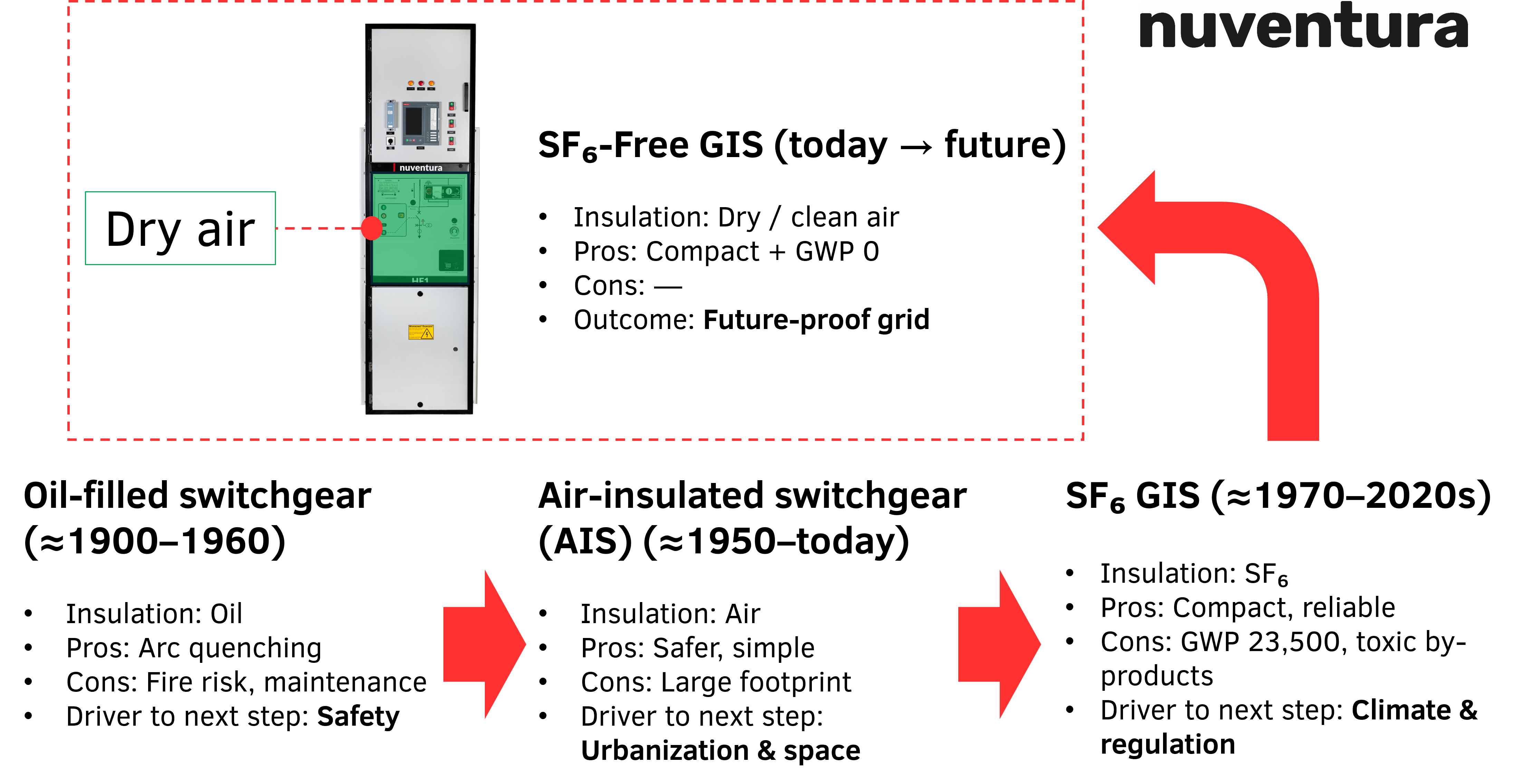
The Evolution of MV Switchgear: From Oil → AIS → SF₆ → SF₆-Free GIS
The Carbon Footprint of SF₆ vs SF₆-Free Switchgear
What Utilities Must Consider in Tender Specifications for SF₆-Free GIS
.png)
Type-Tested MV Switchgear Under IEC 62271-200
_sz3.jpg)
Partial Discharge in MV Switchgear: Causes & Detection
.png)
Key Differences between Primary and Secondary GIS Switchgear
Internal Arc Classification Explained (IAC AFLR, 16/25/31.5 kA Basics)
Environmental Advantages and Potential Carbon Credits to SF₆-free Switchgear in the Indian Context
SF₆ Regulations: What’s Changing (2026–2035)? And Where?
Explanation of the relay protection functions required in MV grids
AIS vs GIS — Combining the Best of Both Worlds with SF₆-Free Technology
Why Voltage Levels Matter in Medium-Voltage Grids
Protection Relays – The Intelligence Behind Medium-Voltage Switchgear
Raising the Bar for Switchgear Safety
Nuventura and Elgór and Hansen enter partnership to bring SF₆-free switchgear to Poland

Nuventura and WESCOSA join forces to bring F-Gas-free GIS to the Middle East

CO7 and Nuventura announce partnership

Nuventura and PMS join forces for a greener future in power solutions

Introducing Nuventura’s ESG function and Cassidy Kuiper
Project Enquiries
Whether it’s SF₆-free switchgear specifications, partnership opportunities or support – our team is ready to answer your questions and find the right eco-friendly solution for your needs.
If you are evaluating SF₆-free switchgear for a new project or looking to replace conventional GIS, our team can help you define the right technical solution. We support customers with product specifications, project planning, partnership discussions and technical clarification throughout the decision-making process. Whether the application is utility, industrial or renewable energy, we work with you to identify the most suitable configuration for your requirements. Contact us to discuss your project in more detail and explore the best SF₆-free option for your application.
Do you have a specific request?
Get in touch