
News
SF₆ Regulations: What’s Changing (2026–2035)? And Where?
Key takeaways for MV (24–36 kV)
- European Union: New SF₆‑using medium‑voltage switchgear up to andincluding 24 kV is banned from being put into operation from 1 Jan 2026. For>24 kV up to and including 52 kV, the ban applies from 1 Jan 2030.
Source: EU F‑gas Regulation 2024/573,Article 13(9).
- United States: California has begun a phase‑out of new SF₆gas‑insulated equipment (GIE) by voltage and configuration starting in 2025;New York adopted a similar phase‑out with first medium‑voltage dates beginning1 Jan 2027.
Sources: CARB “Regulation for GIE” (Final Regulation Order); New York 6 NYCRR Part 495.
- From 1 Jan 2035 in the EU, using virgin SF₆ forservicing/maintenance of switchgear is prohibited (reclaimed/recycled SF₆allowed, with limited exceptions).
Source: EU 2024/573, Article 13(7).
Why SF₆ draws regulatory attention
SF₆ has an extremely high 100‑year GlobalWarming Potential (GWP): 23,500 (IPCC AR5) and 25,200 (IPCC AR6). Field dataand studies for GIS fleets often show annual leakage in the order of ~0.4–1.3%under normal operation, depending on design and practice. Regulators therefore focus both on preventing new SF₆ equipment and on leak‑prevention/servicing controls.
Sources: IPCC/Greenhouse Gas Protocol GWP tables; UK DSA “Generic design risk assessment – SF6” (2021).
Where SF₆ in switchgear is restricted or priced
European Union (binding, in force)
EU Regulation (EU) 2024/573 (in force since 20 Feb 2024) prohibits putting into operation new electrical switchgear using fluorinated greenhouse gases on the following dates:
Class
Voltage / Rating
Ban date (putting into operation)
Medium voltage
≤ 24 kV
1 Jan 2026
Medium voltage
> 24 kV and ≤ 52 kV
1 Jan 2030
High voltage
52–145 kV and ≤ 50 kA short‑circuit
1 Jan 2028
High voltage
> 145 kV or > 50 kA short‑circuit
1 Jan 2032
There are narrow procurement‑basedderogations where no competitive bids for SF₆‑free (or very low‑GWP) equipmentare received, and a service ban on the use of virgin SF₆ from 1 Jan 2035. SeeArticle 13(7), (9), and related paragraphs for the exact wording andexceptions.
Source: Regulation (EU) 2024/573, Article13.
United Kingdom (current position)
Great Britain currently retains F‑gascontrols on handling, labelling, certification and leak‑checking of switchgear,but has not adopted EU‑style SF₆ switchgear phase‑out dates. Operators mustcomply with leak checks and record‑keeping; policy on future bans remains underUK review.
Source: GOV.UK guidance: “High voltageswitchgear containing SF6.”
United States (state action + federal reporting)
California Air Resources Board (CARB) –“Regulation for Gas‑Insulated Equipment (GIE)” – prohibits acquisition of newSF₆ GIE on a schedule by voltage, installation type and short‑circuit ratingbeginning 1 Jan 2025 for the first MV categories, with later dates through 2033for the highest voltages. New York’s 6 NYCRR Part 495 (adopted Dec 2024) setsMV phase‑out dates beginning 1 Jan 2027 (e.g., ≤38 kV above‑ground) and extendsthrough 2033 for >245 kV.
Massachusetts (310 CMR 7.72) does not bannew SF₆ outright but requires that new GIS demonstrate a ≤1.0% annual leak rateand imposes system‑wide emission limits.
Federally, owners above the reportingthreshold must report SF₆ (and covered insulating gas) emissions under the U.S.EPA’s Greenhouse Gas Reporting Program (40 CFR 98 Subpart DD).
Sources: CARB Final Regulation Order forGIE; NY 6 NYCRR Part 495; MassDEP 310 CMR 7.72; U.S. EPA GHGRP Subpart DD.
Nordics & Switzerland
Norway: excise duty on SF₆ applies atimport/production. 2025 rates published by the Norwegian Tax Administrationinclude NOK 33,018 per kg for pure SF₆ and NOK 6,604 per kg for SF₆ containedin products.
Denmark: green excise duty applies toHFCs/PFCs/SF₆; the rate for SF₆ is set in Danish tax schedules (e.g., SKATguidance lists DKK‑per‑kg rates).
Switzerland: no ban, but a federalvoluntary sector‑wide agreement coordinated by Swissmem aims to minimise SF₆consumption and emissions; targets include national emissions limits andreporting.
Sources: Skatteetaten (Norway) SF₆ exciseduty pages; SKAT/MST Denmark; Swiss FOEN/Swissmem voluntary agreement.
Rest of world (selected)
Australia and New Zealand: SF₆ used inpower systems is subject to greenhouse‑gas reporting/levy frameworks (e.g.,Australia’s GHGRP (NGER) Subpart DD‑equivalent reporting for T&D users; NewZealand’s ETS obligations and levies for SGGs).
Sources: Australia NGER Subpart DD pages;NZ EPA / MfE guidance on SGG/ETS.
What this means if you specify 24–36 kV GIS
· In the EU, SF₆‑using 24 kV primary and secondary switchgear can no longer be putinto operation from 1 Jan 2026; 36 kV (within >24–≤52 kV) followson 1 Jan 2030.
· California and New York areconverging on phase‑outs of new SF₆ GIEat MV levels during 2025–2028 (category‑dependent), increasing the value of SF₆‑free portfolios for U.S. utilities.
· Taxes and levies (Nordics) andleak‑rate constraints (e.g., Massachusetts)further increase the total cost of ownership for SF₆ fleets versus SF₆‑free alternatives.
References (quick links)
· EU: Regulation (EU) 2024/573 —Article 13(7) and (9)
· CARB “Regulation for Gas‑Insulated Equipment (GIE)” — Final Regulation Order and Summary
· New York 6 NYCRR Part 495 —Express Terms and law text
· Massachusetts 310 CMR 7.72 —SF₆ emission limits for GIS
· U.S. EPA GHGRP Subpart DD —Electric T&D equipment use
· UK GOV.UK — High voltageswitchgear containing SF₆ (guidance)
· Norway — Skatteetaten SF₆excise duty (rates)
· Denmark — SKAT/MST informationon F‑gas excise
· Switzerland — FOEN/Swissmemvoluntary agreement on SF₆
· IPCC GWPs (AR5/AR6) —Greenhouse Gas Protocol tables
Stay informed and inspired
You can also stay informed and inspired by subscribing to our quarterly newsletter

More News

.png)


Nuventura joins Lucy Electric to accelerate global adoption of SF₆-free primary switchgear

Total Cost of Ownership: SF₆ GIS vs SF₆-Free Dry-Air GIS
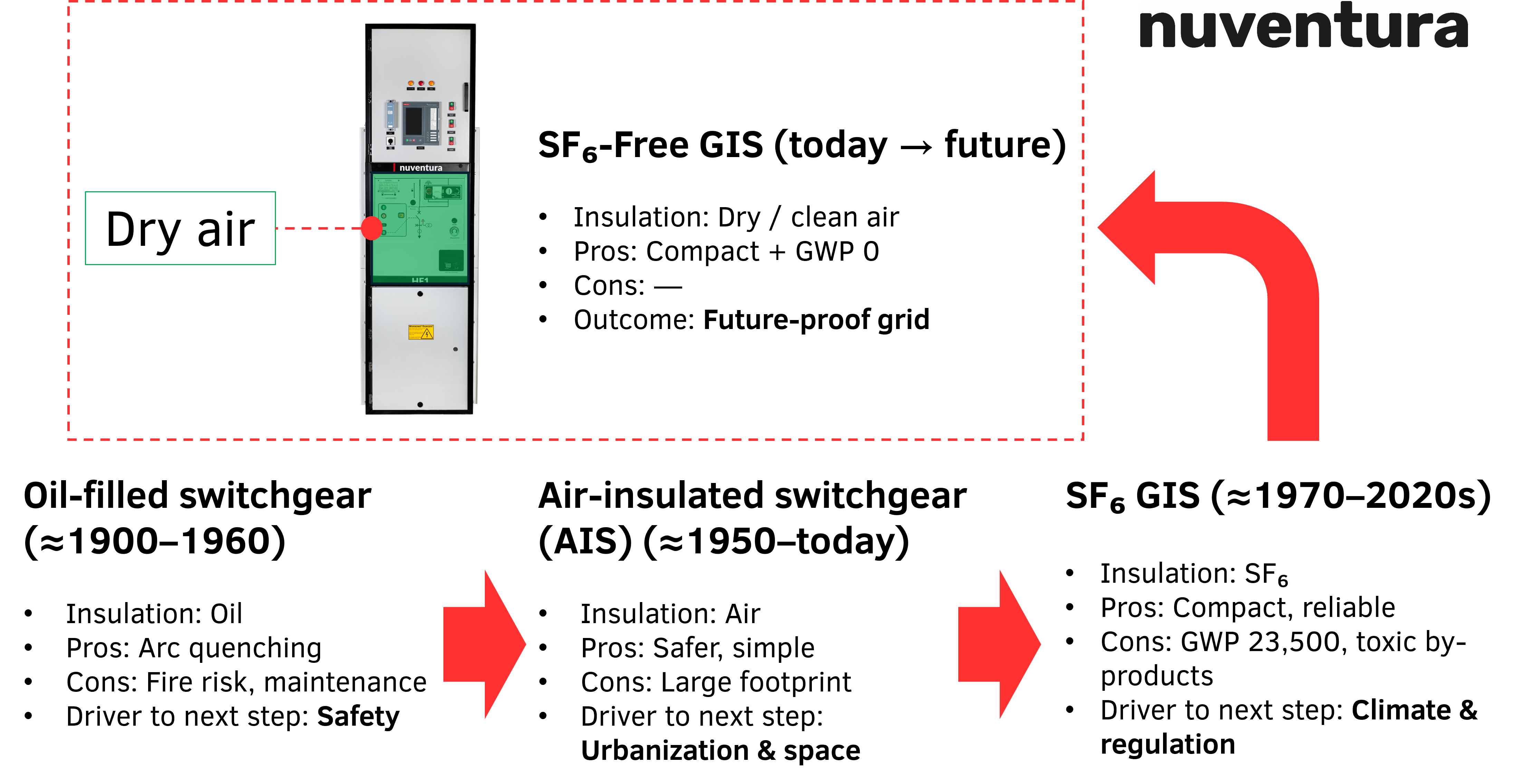
The Evolution of MV Switchgear: From Oil → AIS → SF₆ → SF₆-Free GIS
The Carbon Footprint of SF₆ vs SF₆-Free Switchgear
What Utilities Must Consider in Tender Specifications for SF₆-Free GIS
.png)
Type-Tested MV Switchgear Under IEC 62271-200
_sz3.jpg)
Partial Discharge in MV Switchgear: Causes & Detection
.png)
Key Differences between Primary and Secondary GIS Switchgear
Internal Arc Classification Explained (IAC AFLR, 16/25/31.5 kA Basics)
Environmental Advantages and Potential Carbon Credits to SF₆-free Switchgear in the Indian Context
SF₆ Regulations: What’s Changing (2026–2035)? And Where?
Explanation of the relay protection functions required in MV grids
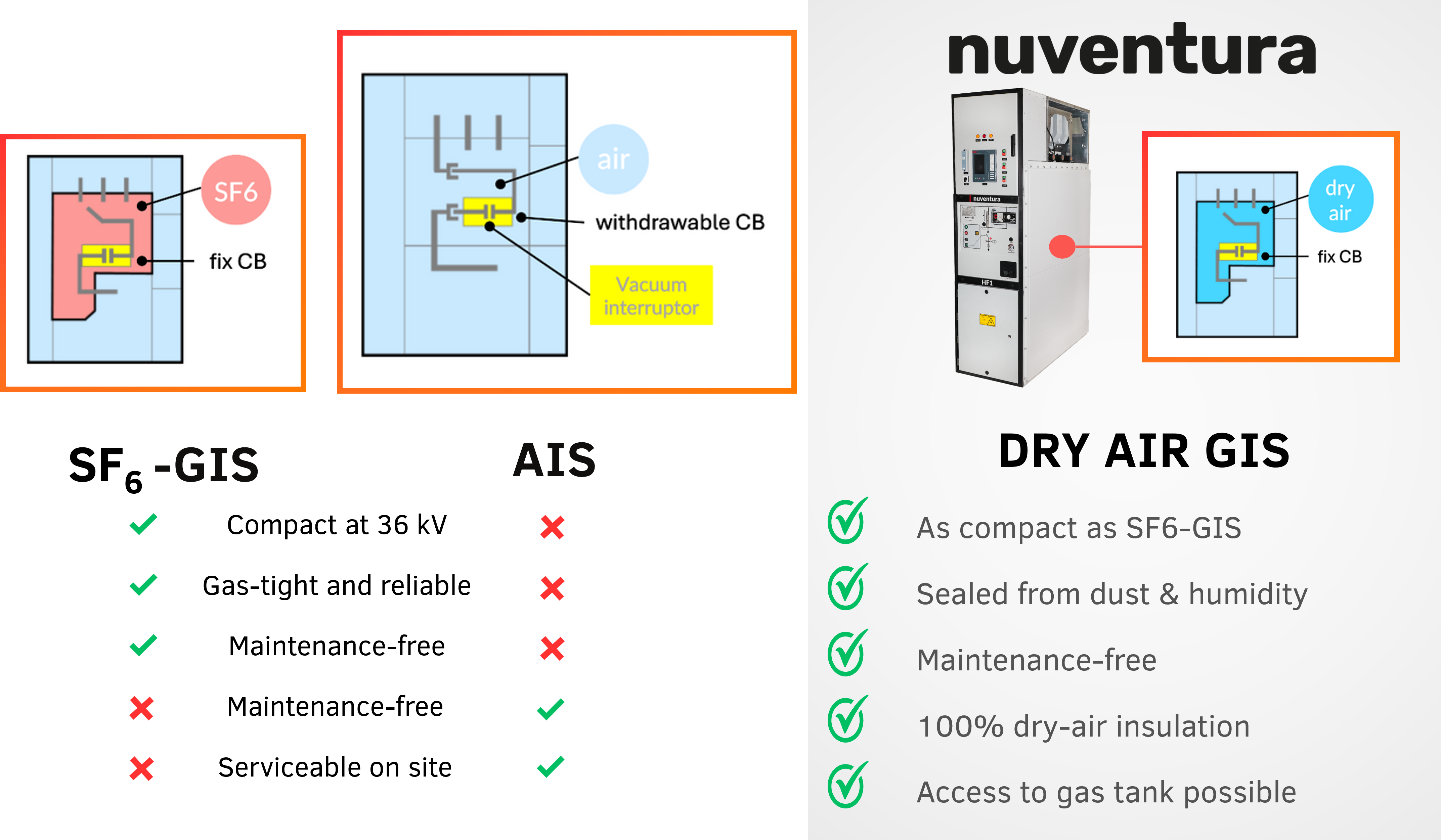
AIS vs GIS — Combining the Best of Both Worlds with SF₆-Free Technology
Why Voltage Levels Matter in Medium-Voltage Grids
Protection Relays – The Intelligence Behind Medium-Voltage Switchgear
Raising the Bar for Switchgear Safety
Nuventura and Elgór and Hansen enter partnership to bring SF₆-free switchgear to Poland

Nuventura and WESCOSA join forces to bring F-Gas-free GIS to the Middle East

CO7 and Nuventura announce partnership

Nuventura and PMS join forces for a greener future in power solutions

Introducing Nuventura’s ESG function and Cassidy Kuiper
Project Enquiries
Whether it’s SF₆-free switchgear specifications, partnership opportunities or support – our team is ready to answer your questions and find the right eco-friendly solution for your needs.
If you are evaluating SF₆-free switchgear for a new project or looking to replace conventional GIS, our team can help you define the right technical solution. We support customers with product specifications, project planning, partnership discussions and technical clarification throughout the decision-making process. Whether the application is utility, industrial or renewable energy, we work with you to identify the most suitable configuration for your requirements. Contact us to discuss your project in more detail and explore the best SF₆-free option for your application.
Do you have a specific request?
Get in touch